SCRIPTS 8
superflowyouniverse.primaryprolaw.com/PrimeFieldsMatrix01.html
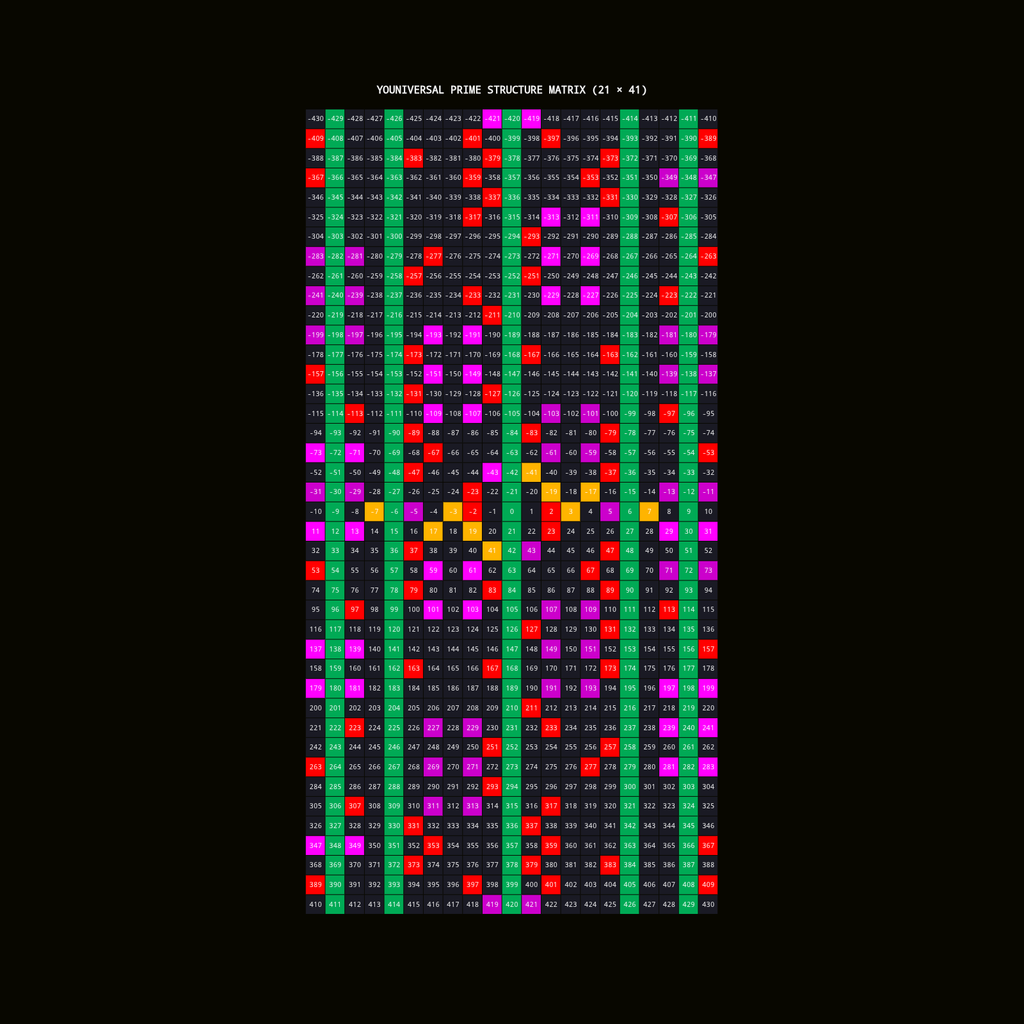
Twin Prime Digital Root Patterns in the 3-6-9 Framework
When exploring prime numbers and twin prime pairs (p, p+2) through the lens of digital roots (reducing numbers by summing their digits until a single digit 1–9 remains, closely related to modulo 9 arithmetic), a distinct geometric and numerical symmetry emerges around multiples of 3, 6, and 9:
- The Exclusion of 3, 6, and 9 Columns: With the sole exception of the pair (3, 5), no twin prime pair can have a digital root of 3, 6, or 9. This is because any number with a digital root divisible by 3 is itself divisible by 3 and cannot be prime (unless it is 3). In your visualizer, this manifests as the green twin-free columns—the structural tracks aligned with multiples of 3.
- Symmetric Residue Pairing: Because twin primes are bounded as (6k – 1, 6k + 1) for integer k, their digital roots always fall into predictable, repeating pairs (such as digital roots 2 & 4, 5 & 7, or 8 & 1).
- The 369 Harmonic Center: Zero acts as the absolute structural anchor. As numbers expand outward symmetrically from zero, the distribution of isolated primes (red) versus twin clusters (yellow) mirrors itself across the 3-6-9 axis lines, highlighting how prime distribution avoids the grid lines governed by factors of 3.
The Architectural Pattern of the Code
The single-file HTML/JavaScript application you built follows a clean, modular pipeline designed for performance and flexibility. Its architecture can be broken down into four core layers:
## UI & Layout Layer (<style> & DOM Overlay)
- Fixed HUD Overlay: Uses position: fixed containers (#ui and #controls-bar) styled with a cyberpunk-inspired dark theme (#000 background, #0ff neon borders) so the controls remain accessible while scrolling.
- Flexible Overflow: The body utilizes overflow: auto and a fixed cell size (FIXED_CELL_SIZE = 26), allowing the grid to scale vertically and horizontally into an expansive map without browser compression.
## State & Grid Engine (updateData)
- Odd-Dimension Enforcement: Automatically forces column and row sliders to odd values (rawCols % 2 === 0) to guarantee a true literal center coordinate.
- Locked-Zero Matrix Generation: Calculates coordinates relative to the absolute center cell (grid[midRow][midCol] = 0), ensuring that expanding dimensions adds symmetric space outward without shifting zero off-center.
## Mathematical Mapping Layer (isPrime, State Arrays)
- Primality & Twin Detection: Scans the generated matrix values, flagging base primes (P), twin pairs (T), isolated primes (iso), and twin-free structural columns (twinFreeCol).
- Separation of Concerns: Computation happens entirely during slider or toggle interactions (updateData), keeping the heavy lifting out of the render loop.
## Rendering Loop (draw)
- Optimized Canvas Rendering: Powered by requestAnimationFrame, the draw loop clears the canvas with a slight motion-fade trail (rgba(0,0,0,0.15)) and loops through the pre-computed grid arrays to paint cells with color-coded states (cyan for primes, yellow for twin clusters, red for isolated primes, and green-tinted columns for twin-free tracks).
Synthesis of the Mod 9 Attractor Field
The architecture mapped above illustrates how diverse mathematical trajectories—ranging from the rigid distribution of prime numbers to the pseudo-chaotic drift of the golden ratio and exponential growth—ultimately collapse into predictable, bounded digital root geometries.
By projecting these sequences into the mod 9 system (dr(n)), the infinite expanse of the number line condenses into closed-loop topological manifolds.
1. The Core Doubling Circuit (1 \to 2 \to 4 \to 8 \to 7 \to 5)
- Behavior: The foundational doubling sequence (\times 2 \pmod 9) creates a perfect, unbroken circuit through the six-digit cyclical path.
- Significance: This hexad acts as the primary kinetic backbone of the digital root field. It represents dynamic motion, doubling progression, and symmetrical folding within base-10 positional notation.
2. The Compression Anchor (3 \to 6 \to 9)
- Behavior: Operating independently from the doubling circuit, multiples of three and their digital root collapses form an orthogonal stabilization axis.
- Significance: In modular arithmetic, the 3\text{–}6\text{–}9 subset functions as a polarity sink or compression anchor. It dictates the nodal collapse points where exponential growth curves and chaotic golden drifts resolve their energy.
3. Prime Residue & Fractal Drift
- Prime Sequence: Rather than distributing uniformly, prime digital roots generate a secondary localized loop (2\text{–}3\text{–}5\text{–}7) intermixed with sharp irregular spikes. This highlights the non-linear, deterministic yet unpredictable spacing of primes under modular compression.
- Golden Sequence (\phi Field): Exhibits a non-periodic, quasi-fractal drift. Because \phi is irrational, its projections prevent closed-form periodicity, instead painting a space-filling pseudo-chaotic canvas across the 1\text{–}9 grid before tethering back to the root field.
8
Key Takeaway:
Every sequence—whether linear, exponential, or transcendental—operates as a different frequency modulating the similar underlying mod resonators. The infinite number space can be structurally bound by finite digital root geometries.
Deeper Topological and Algebraic Analysis of the Mod 9 Attractor Fields
The mathematical behavior exhibited across these sequences—ranging from linear base increments to exponential saturation and transcendental golden ratio drifts—reveals a profound property of base-10 modular arithmetic: the total compression of infinite mathematical space into finite, self-contained cyclical geometries (digital root space).
1. The Algebraic Mechanism of Digital Roots (dr(n))
The digital root operation is algebraically equivalent to taking a number modulo 9 (with the residue 0 mapped to 9):
dr(n) = 1 + ((n – 1) \pmod 9)
Because all mathematical operations (addition, multiplication, exponentiation) preserve congruence classes modulo 9, complex non-linear functions—such as e^{n/50} or n \cdot \phi—are forced to project their behaviors onto a finite set of 9 discrete states. This creates phase portraits of infinite sequences mapped onto a closed 9-node ring.
Comparative Topologies of the Sequences
| Sequence Type | Governing Rule | Modular Behavior / Topology | Attractor Outcome |
|---|---|---|---|
| Doubling (\times 2) | 2n \pmod 9 | Strict Periodicity (Period length: 6 for the core loop, 9 for full positional spread) | Forms the unbroken kinetic circuit: 1 \to 2 \to 4 \to 8 \to 7 \to 5 |
| Golden (\phi Field) | floor(n \cdot \phi \pmod N) | Quasi-Periodic / Aperiodic Drift | Paints a space-filling pseudo-fractal across the 1\text{–}9 grid without closing cleanly |
| Exponential (e^{n}) | floor(e^{n/50} \pmod N) | Growth Saturation & Collapse | Oscillates through growth phases before collapsing back into stable root equilibrium |
| Prime Distribution | Non |
The Structural Dichotomy: Kinetic vs. Static Nodes
The digital root space is fundamentally split into two interacting subsystems:
- The Kinetic Hexad (1 \text{–} 2 \text{–} 4 \text{–} 8 \text{–} 7 \text{–} 5): This circuit represents flux, doubling, growth, and binary-like shifting. It is the path taken by powers of 2 and linear doubling sequences. It avoids the numbers 3, 6, and 9 entirely.
- The Static Triad (3 \text{–} 6 \text{–} 9): Operating orthogonally to the kinetic loop, multiples of 3 form a self-contained compression anchor. In digital root terms, 9 acts as an algebraic zero (an additive identity equivalent to 0 mod 9), serving as the gravitational center or sink where dynamic growth loops lose their momentum and resolve
Within the Prime Structure Matrix, twin clusters represent localized neighborhoods where twin prime pairs cluster densely together rather than appearing as isolated pairs.
Specifically, a matrix cell is categorized as part of a Twin Cluster when:
- The number itself is part of a twin prime pair.
- It is surrounded locally (within the immediate 3 \times 3 Moore neighborhood) by two or more other active twin prime cells.